Collecting for the Super Nintendo: A Practical Guide
Updated August 22, 2026
The SNES is one of the most counterfeited consoles in collecting, and one of the most rewarding to collect carefully. Both facts have the same cause: the games are desirable enough to be worth faking.
Assume reproductions exist, then rule them out
Reproduction SNES cartridges are produced in volume and sold openly, and plenty end up misrepresented as originals further down the chain. This is not a reason to avoid the console, it is a reason to develop a checking habit and apply it every time.
The tells are consistent. Original labels have crisp printing and a slight sheen, and sit flush in the shell recess. Reproductions frequently have labels that are marginally the wrong size, colours that are close but not right, or a matte finish where the original was glossy. Compare against a copy you already trust rather than against memory.
The screw is the next check. Original cartridges use a 3.8mm security screw; a standard Phillips screw means the shell has been opened or replaced. Neither is conclusive alone, but an unusual label and a Phillips screw together is enough to walk away.
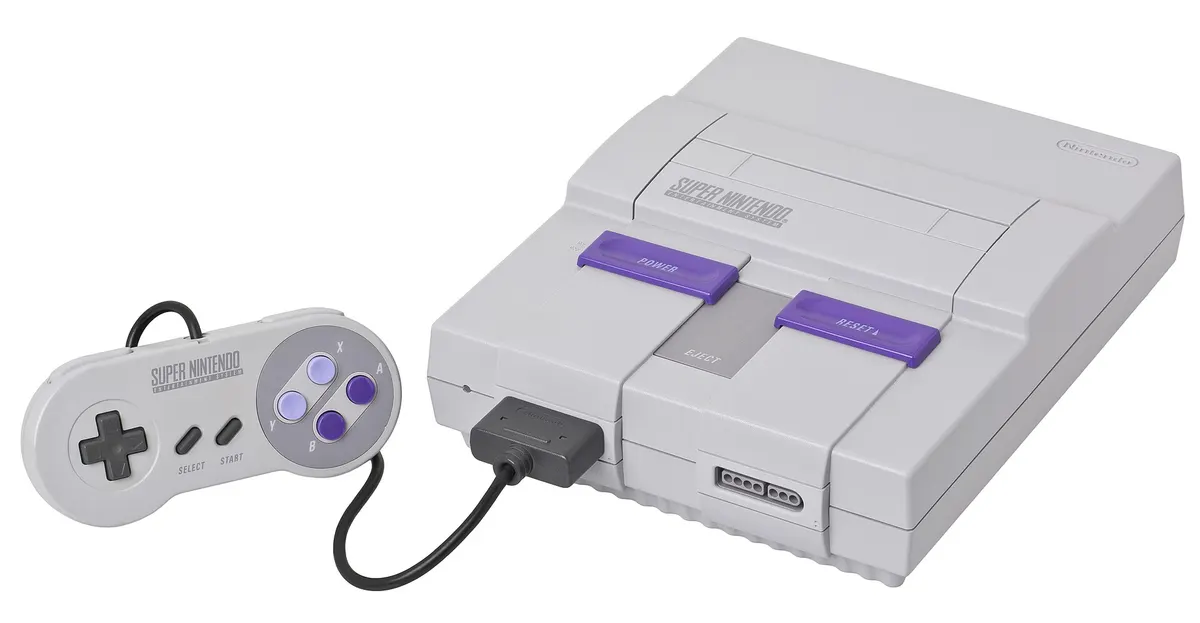
Yellowing is cosmetic, and it is not always reversible
Many SNES shells discolour to a yellow-brown over time. It is a property of the plastic reacting to light and age, it does not affect whether the game works, and it varies between production batches, which is why two copies stored side by side can look different.
There are treatments that reduce it, and they carry real risk: over-treatment can leave the plastic brittle or blotchy, and the change can return. For a collector the useful position is to treat colour as a condition attribute you record rather than a problem you must solve, and to buy accordingly.
Why boxed SNES games cost what they do
Like the N64, SNES games shipped in cardboard boxes that were rarely kept. Unlike the N64, the SNES has a large and enthusiastic collector base competing for the boxed copies that survived, which is what pushes prices for complete examples well beyond the loose cartridge.
Inserts are the detail that separates a good complete copy from an ordinary one. Many SNES releases included more than a manual: poster inserts, registration cards, and protective dust sleeves. A copy described as complete without a list of what is inside is worth a question before it is worth a bid.
Regional sets are three different projects
The North American SNES, the Japanese Super Famicom and the PAL SNES use different cartridge shapes and different shell designs, and their libraries do not match. A great many Super Famicom titles never left Japan, and PAL releases were often both later and scarcer.
Super Famicom collecting is worth a specific mention because it upends the usual economics: the cartridges are frequently cheaper than their Western equivalents, and because Japanese releases were sold in card boxes that people kept, complete copies survive in far greater numbers. If boxed SNES prices have put you off, the Japanese library is often the more achievable project.
Buy fewer, better copies
The most common regret in SNES collecting is a shelf of copies bought quickly and cheaply that all need replacing later. Because the desirable titles hold value well, an upgrade path is expensive, and the money spent on the first copy is largely gone.
Where a game matters to you, waiting for the right copy is almost always cheaper than buying twice. Where it does not, a loose cartridge in honest condition is perfectly good and always will be. The mistake is applying the wrong standard to the wrong game.
Record condition per copy
SNES collecting produces duplicates on purpose: a loose player copy, a boxed shelf copy, sometimes a Japanese original alongside a Western release. A catalog that records one row per game cannot represent that, and it is the thing that makes a collection record stop matching the shelf.
Retro Collection Index records each physical copy separately, with condition, region and purchase price on each, so what you own is described accurately rather than approximately.